Start at 77T. Move Down for Deposit. Move Up for Detail.
Screen printers spend a lot of time removing variables from production. We standardise inks, exposure settings, squeegee pressure, dryer temperatures and artwork requirements because consistency makes a print shop easier to run.
Mesh selection should be treated the same way.
Many shops build up a large collection of mesh counts over time. A new mesh is purchased for one unusual job, another gets recommended by a supplier, and a third is added because one printer prefers it over what is already on the rack. Before long, choosing a screen becomes a fresh technical decision for every piece of artwork.
More options can feel like more control. In practice, they can create more hesitation, more inconsistency and more opportunities for staff to make different decisions on similar jobs.
For most garment screen printing shops, the overwhelming majority of everyday customer artwork can be funnelled through three mesh counts:
43T, 77T and 100T.
The goal is not to pretend these are the only mesh counts worth owning. There will always be specialised jobs that require something outside the system. The goal is to create reliable defaults so your team is not starting from zero every time artwork enters production.
The rule is simple:
Start at 77T. Move down to 43T for more deposit. Move up to 100T for more detail.
That one decision framework can simplify screen inventory, artwork review, staff training and production planning across the entire shop.
Too Many Mesh Choices Can Slow Production
Mesh count selection is usually presented as a technical problem: assess the artwork, consider the ink, determine the required deposit and choose the ideal screen.
That is correct, but it can become unnecessarily complicated when a shop treats every job as unique.
One printer may choose 62T for an underbase. Another may use 77T. Someone else reaches for 90T because that is what they used at their previous workplace. All three choices may technically work, but the shop now has three different production approaches for what is essentially the same type of job.
That variation follows the screen through the entire process. Different mesh counts can change coating behaviour, exposure requirements, ink deposit, print pressure, flash performance and the appearance of the finished colour. When a repeat order returns, the result may depend on whether the same screen specification was documented and followed.
Standardisation reduces those differences.
Instead of asking, “What mesh count could work for this job?”, the production team asks a much simpler question:
Does this artwork need heavy deposit, general production or fine detail?
That turns mesh selection from an open-ended debate into a fast classification system.
43T: The Heavy-Deposit Screen
The 43T screen belongs in the heavy-deposit lane.
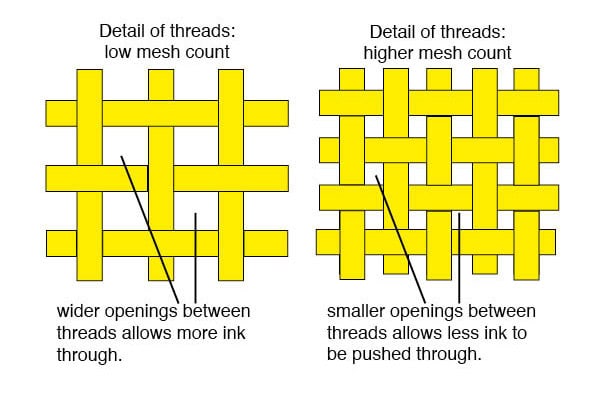
It is the choice when coverage, opacity or ink-film thickness matters more than retaining very fine detail. Its more open mesh allows a greater volume of ink to pass through the screen, making it useful for bold artwork and applications that need a stronger deposit.
Typical uses include opaque white prints, heavier underbases, block lettering, athletic graphics, workwear designs, puff inks and selected specialty products. It can also be useful when printing onto textured or absorbent garments where a finer screen may struggle to leave enough ink behind.
That does not mean every white ink should automatically be printed through 43T. A coarse mesh can produce more deposit than the job needs, creating a heavier hand feel, longer flash times or unnecessary ink consumption. The stencil, squeegee, pressure and print stroke still need to be controlled.
The purpose of 43T within the system is straightforward: use it when the artwork or ink needs more body.
If opacity is the priority and the design is not relying on very fine detail, 43T is the first place to look.
77T: The Everyday Workhorse
If the shop is going to build its workflow around one default screen, it should be 77T.
It sits in the useful middle ground between ink deposit and image detail. It can carry enough ink for strong garment printing while still holding the lines, shapes and moderate detail found in most commercial artwork.
Logos, brand graphics, standard spot-colour designs, common underbases, medium-detail illustrations and general garment work can usually begin here. For many shops, 77T can handle the largest share of daily production without forcing a major compromise in either coverage or print definition.
This is why the central rule begins with 77T.
Start at 77T unless the artwork, ink or garment gives you a clear reason not to.
That last part matters. The decision should not be based on habit or whichever screen happens to be clean. There should be a practical reason to leave the default.
Move down when the job needs more ink deposit. Move up when it needs more detail or a thinner ink film. If neither condition applies, remain at 77T.
The more frequently a shop uses the same mesh specification, the more predictable that mesh becomes. Staff learn how it coats, exposes, washes out, registers and prints. They become familiar with the pressure required to clear it and the amount of ink it leaves behind.
That familiarity is valuable. A screen that behaves predictably is easier to troubleshoot than one selected from a rack of rarely used alternatives.
100T: The Fine-Detail Screen
The 100T screen is the detail lane.
It becomes useful when fine lines, small text, halftones or detailed illustrations are at risk of being overwhelmed by excess ink deposit. Its finer mesh produces a thinner ink film and gives the stencil more support around smaller image elements.
Typical applications include detailed line work, smaller typography, cleaner halftones, highlight whites and artwork where sharpness matters more than maximum opacity.
Moving to 100T is not automatically an upgrade in print quality. A finer mesh simply changes the balance between detail and deposit. If the ink is too thick, the stencil is poorly prepared or the press operator compensates with excessive pressure, the benefits of the finer mesh can quickly disappear.
It may also take additional print strokes or a carefully designed underbase to achieve opacity on dark garments. That is the trade-off: more control over detail, but less ink being delivered with each stroke.
Within the three-mesh system, 100T is selected when 77T is likely to put down more ink than the artwork can comfortably carry.
A Simple Artwork-Funneling System
The strength of this approach is not the individual mesh counts. It is the way they create a repeatable decision process.
Every incoming artwork file begins in the same place: 77T.
From there, the production team only needs to decide whether the job requires a move in either direction.
Move down to 43T when deposit is the priority
The artwork may contain bold shapes, heavy underbases or large opaque areas. The ink may be thick, textured or designed to produce a specialty effect. The garment surface may require more ink to achieve suitable coverage.
In those cases, the job moves into the heavy-deposit lane.
Stay at 77T for general production
The artwork contains normal commercial detail, the ink behaves well through a medium mesh and there is no unusual requirement for either heavy coverage or a particularly thin deposit.
This is where the majority of everyday garment jobs should land.
Move up to 100T when detail is the priority
The artwork contains fine lines, small text, controlled halftones or detailed elements that could close up under a heavier ink film.
In those cases, the job moves into the detail lane.
This system gives staff a default answer before production begins. They are no longer choosing from every mesh count on the rack. They are placing the job into one of three established production categories.
When Should You Move Outside the System?
Standardisation should simplify decisions, not replace technical judgement.
Some jobs will genuinely need a mesh outside 43T, 77T and 100T. Extremely fine halftones, process printing, specialised industrial inks, unusually large particles, technical substrates or tightly controlled ink films may require a different specification.
The important distinction is that these should be treated as exceptions.
Above 100T, a garment print usually needs a specific technical reason. The shop should be able to explain what the higher mesh count is solving: finer tonal control, reduced deposit, specialised ink behaviour or image detail that cannot be held reliably through the standard screens.
The same principle applies below 43T. Very coarse mesh may be justified for large particles, unusually heavy deposits or particular specialty effects, but it should not become another everyday option without a clear production need.
A standardised shop is not a shop that refuses to deviate. It is a shop that only deviates deliberately.
Mesh Count Is Not the Whole Specification
A three-mesh system is a strong operational framework, but mesh count alone does not determine how a screen will print.
Thread diameter affects the open area of the mesh. Two screens with the same nominal mesh count can produce different ink deposits if one uses a thicker thread. Mesh tension affects how cleanly the screen releases from the garment and how much pressure is needed to clear the image.
Stencil thickness also matters. The same 77T mesh can deliver a different ink film depending on how the screen is coated and the resulting emulsion-over-mesh thickness.
Ink viscosity, squeegee hardness, blade profile, print angle, pressure, stroke speed, off-contact and garment texture all influence the final result as well.
This does not weaken the case for standardisation. It strengthens it.
Once the shop reduces the number of mesh counts in regular use, it becomes easier to control the other variables around them. Exposure tests can be built around those screens. Coating procedures can be documented. Suitable squeegee combinations can be established. Print teams can learn how each screen responds under normal production conditions.
The mesh count becomes part of a complete production standard rather than a number chosen in isolation.
Standardisation Makes Training Easier
One of the clearest benefits appears when training new staff.
A new printer can easily become overwhelmed by a rack containing many mesh counts with overlapping applications. They may understand that a coarse mesh lays down more ink and a fine mesh holds more detail, but translating that principle into a confident production choice takes experience.
A three-mesh system gives them a practical structure:
43T for deposit
77T for everyday production
100T for detail
That is easy to teach, easy to remember and easy to reinforce.
As the printer gains experience, they can learn the exceptions and understand why a job may need to move outside the standard. The technical knowledge is still developed, but it is built on a clear operating framework rather than a list of loosely defined choices.
This also makes mistakes easier to identify. If a bold underbase was accidentally sent to 100T, the problem becomes obvious during the artwork or screen review stage. If a fine halftone was assigned to 43T, the job can be redirected before time is spent coating and exposing the wrong screen.
Repeat Orders Become More Predictable
Repeatability is one of the strongest arguments for simplifying mesh selection.
A repeat customer expects the print to look like the previous order. That becomes harder when the mesh count changes, because mesh affects ink deposit, opacity, surface finish and colour appearance.
The ink mixed correctly for one mesh may appear different through another. This is particularly noticeable with bright colours, fluorescent inks, transparent systems and prints where the garment colour influences the final appearance.
By funnelling common artwork into a smaller number of standard screens, the shop reduces the likelihood of production drift between orders. The same artwork is more likely to return to the same mesh category, giving the printer a more reliable starting point.
Standardisation does not eliminate the need for job records. Mesh count, thread specification, tension, stencil method, squeegee, ink formula and cure settings should still be documented. It simply makes those records easier to follow because fewer combinations are being used.
Screen Inventory Becomes Easier to Manage
A simplified mesh system also changes how screens are purchased, stored and maintained.
Instead of owning a small number of frames across many mesh counts, the shop can hold a deeper working inventory of the screens it uses most often. More 77T screens can be kept ready for general production, with appropriate numbers of 43T and 100T screens supporting the heavier and finer work.
That makes production scheduling easier. The shop is less likely to discover that the only screen in an unusual mesh count is already in use, damaged or waiting to be reclaimed.
Remeshing decisions become clearer as well. Frames can be returned to one of the three standard lanes based on actual job demand, rather than rebuilding a fragmented collection of screens that rarely leave the rack.
The result is not just a neater inventory. It is a screen department that is better aligned with the work the shop actually produces.
The Goal Is Fewer Unnecessary Decisions
A print shop does not become more professional by making every decision more complicated.
It becomes more professional by identifying the decisions that matter, establishing strong defaults and reserving deeper technical analysis for the jobs that genuinely need it.
Mesh count is an ideal place to apply that thinking.
For most everyday garment artwork, 43T, 77T and 100T create three useful production lanes. They cover heavy deposit, general production and fine detail without forcing staff to debate small differences between a long list of overlapping options.
There will always be specialist work beyond those screens. That work should remain available, but it should sit outside the normal workflow rather than define it.
Key Takeaway
Standardising mesh count is not about limiting what your shop can print. It is about reducing the amount of unnecessary thinking required to print it.
A strong default system makes artwork review faster, staff training easier, screen inventory cleaner and repeat orders more predictable. It gives the entire team a shared production language and makes exceptions easier to recognise.
The rule is simple:
Start at 77T. Move down for deposit. Move up for detail.
Use 43T when the job needs more ink.
Use 77T for the majority of everyday garment production.
Use 100T when fine detail or a thinner ink film becomes the priority.
Everything outside those three should have a clear technical reason.
Fewer mesh counts. Better defaults. More consistent printing.
Want more like this?
We break down real production problems like this based on what we’re seeing in shops every day.
If you want more technical insights, setup tips, and practical fixes—join the email list and stay in the loop – Sign up here
FAQs
What mesh count should most garment screen printing jobs start with?
For most everyday garment printing, 77T is the best starting point. It offers a practical balance between ink deposit and image detail, making it suitable for standard logos, spot-colour artwork, underbases and medium-detail designs.
A simple rule is:
Start at 77T. Move down for more deposit. Move up for more detail.
When should I use 43T mesh?
Use 43T when the job needs a heavier ink deposit. It is well suited to bold underbases, opaque whites, block artwork, workwear graphics, puff inks and selected specialty products.
Because it lays down more ink, it can improve coverage, but it may also create a heavier print if the stencil, pressure and print stroke are not controlled.
When should I use 100T mesh?
Use 100T when fine detail is more important than maximum ink deposit. It is useful for small text, fine lines, detailed illustrations, halftones and highlight whites.
The trade-off is a thinner ink film, so dark garments may require a carefully designed underbase or additional print strokes to achieve the required opacity.
Can 43T, 77T and 100T handle every screen printing job?
They can handle the overwhelming majority of everyday garment printing jobs, but not every possible application. Extremely fine halftones, process printing, large-particle specialty inks, technical substrates and other specialised work may require a mesh outside the three-count system.
The aim is not to eliminate every other mesh count. It is to make anything outside the system a deliberate exception.
Does mesh count alone determine ink deposit and print detail?
No. Mesh count is only one part of the screen specification. Thread diameter, mesh tension, stencil thickness, ink viscosity, squeegee hardness, print pressure, stroke speed, off-contact and garment texture also affect the final print.
Standardising mesh counts makes these additional variables easier to control and document.